We may earn a commission from links on this page, at no extra cost to you. Here’s how we test and our affiliate disclosure.
For paid-traffic (PPC) landing pages, Unbounce is the better tool — and Leadpages is the better value. Unbounce wins for PPC because of three features built for ad traffic: dynamic text replacement (which matches your page headline to the exact ad keyword and lifts Quality Score), Smart Traffic (auto-routes each visitor to the variant most likely to convert), and deeper A/B testing. The trade-off is price and visitor caps — those conversion features live on Unbounce’s higher tiers ($149+/month) and every plan meters your traffic. Leadpages is the smarter pick if budget matters: it includes unlimited traffic on every plan, bundles A/B testing from its mid tier, and even builds full websites, all from around $49/month. Run high-spend, keyword-tight ad campaigns? Choose Unbounce. Running lean, or want one tool for pages and sites? Choose Leadpages.
Leadpages vs Unbounce at a glance
Here’s the head-to-head before the detail. We’ve flagged the winner for PPC specifically.
| Factor | Leadpages | Unbounce 🏆 (PPC winner) |
|---|---|---|
| Starting price | ~$49/mo (annual) | $29/mo (Starter) |
| Traffic limits | Unlimited on all plans ✅ | Metered (500–50,000 visitors by plan) |
| A/B testing | From mid tier (~$99) | Robust, from $149 (Experiment) |
| Dynamic text replacement | No | Yes ✅ (key for PPC) |
| Smart Traffic (AI routing) | No | Yes ✅ (from $249 Optimize) |
| Builds full websites | Yes ✅ | Landing pages & popups only |
| Best for | Budget, unlimited traffic, simplicity | High-spend PPC, conversion optimization |
Confirm live pricing on the Leadpages pricing page and Unbounce pricing page before buying — both run frequent promotions.
Why Unbounce wins for PPC
If your landing pages exist to catch paid ad clicks, three Unbounce features move the needle in ways Leadpages can’t match.
Dynamic Text Replacement (DTR) swaps text on the page to mirror the keyword someone searched. Search “emergency plumber Austin,” land on a page whose headline reads “Emergency Plumber in Austin.” That message match raises ad relevance and Quality Score, which lowers your cost-per-click. For keyword-heavy Google Ads accounts this alone can pay for the subscription.
Smart Traffic uses machine learning to send each visitor to the page variant most likely to convert them, often beating a traditional A/B test because it personalizes instead of picking one global winner. A/B testing on Unbounce is also deeper, letting you run multiple variants with detailed analytics. The catch: DTR and Smart Traffic sit on the pricier tiers, and every plan caps monthly visitors with overage charges if you blow past the limit — something to watch on a scaling campaign.
Why Leadpages wins on value
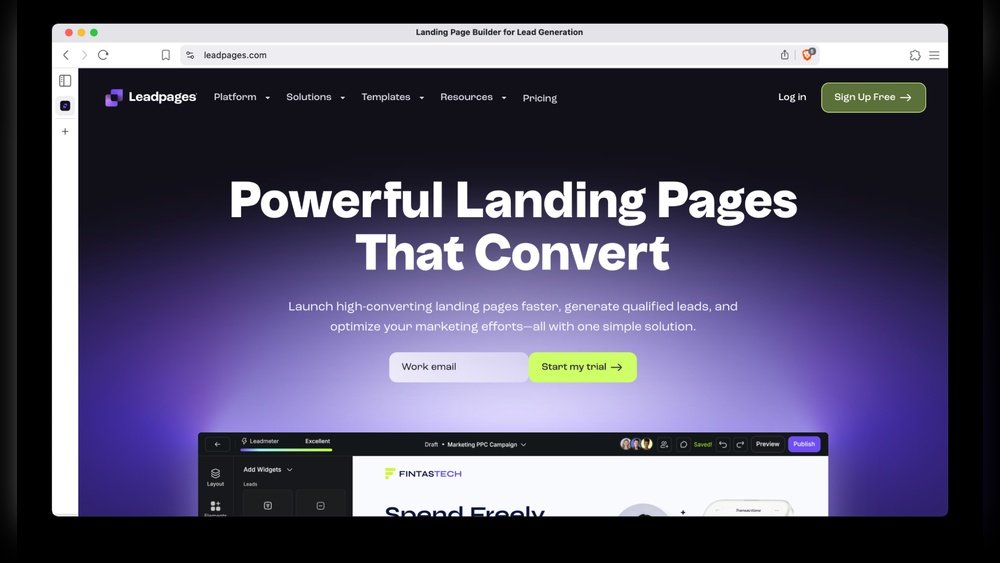
Leadpages, rebuilt for 2026, makes a strong case for everyone who isn’t running enterprise-level ad spend.
The headline advantage is unlimited traffic on every plan — no visitor caps, no overage surprises when a campaign takes off. It’s also genuinely easier for beginners, ships hundreds of mobile-responsive templates, includes lead pop-ups and alert bars, and can publish full websites, not just standalone pages. A/B testing is bundled from the mid tier. For a small business, a solo marketer, or an agency that wants one affordable tool to handle pages and a simple site, Leadpages delivers most of the conversion value at a lower, more predictable cost. You give up DTR and Smart Traffic — but if your campaigns aren’t tightly keyword-segmented, you may never miss them. See how both stack up against the field in our tested ranking of the top 10 landing page builders for 2026.
Pricing compared
Pricing is where the two philosophies diverge most clearly.
Leadpages starts around $49/month (billed annually) and runs up through roughly $99 and $199 tiers, with unlimited traffic at every level and A/B testing from the mid plan. Unbounce starts at $29/month (Starter, 500 visitors), then Build at $99 (20,000 visitors), Experiment at $149 (adds robust A/B testing, 30,000 visitors), and Optimize at $249 (adds Smart Traffic, 50,000 visitors), with annual billing saving about 25%. The real comparison isn’t the sticker price — it’s that Unbounce’s PPC-grade features start at $149+ and your bill can climb with traffic, while Leadpages keeps costs flat as you scale. Budget accordingly based on your ad volume.
Pros and cons
Leadpages — pros: unlimited traffic on all plans, beginner-friendly, builds full websites, affordable, lots of templates. Cons: no dynamic text replacement, no AI traffic routing, less advanced A/B testing.
Unbounce — pros: dynamic text replacement, Smart Traffic AI routing, deep A/B testing, strong enterprise integrations (Salesforce, HubSpot), conversion-focused templates. Cons: pricier, visitor caps with overage fees, steeper learning curve, landing pages/popups only.
The verdict
Choose Unbounce if PPC conversion is your priority and your ad spend justifies it — the message match from dynamic text replacement plus Smart Traffic genuinely lifts results on keyword-tight campaigns. Choose Leadpages if you want the best value, unlimited traffic, beginner-friendly building, or one tool that also doubles as a website builder. Most small businesses and solo marketers will be happier (and spend less) on Leadpages; high-spend performance marketers and agencies running segmented Google Ads will earn back Unbounce’s premium. Still deciding on your overall stack? Start with our guide to the best sales funnel builders for 2026 or browse all our sales funnel guides.
Try Unbounce free → | Try Leadpages free →
Frequently asked questions
Which is better for PPC, Leadpages or Unbounce?
Unbounce is better for PPC. Its dynamic text replacement matches your landing page headline to the searched keyword, which improves ad relevance and Quality Score, while Smart Traffic and deeper A/B testing squeeze more conversions from paid clicks. Leadpages is excellent and more affordable, but lacks dynamic text replacement and AI traffic routing. For high-spend, keyword-segmented campaigns, Unbounce’s premium features usually pay for themselves; for simpler or lower-budget campaigns, Leadpages is plenty.
How do Leadpages and Unbounce differ on pricing?
Leadpages starts around $49/month (annual) and includes unlimited traffic on every plan, with A/B testing from its mid tier. Unbounce starts at $29/month but meters visitors on every plan (500 to 50,000 depending on tier) with overage charges, and its key PPC features — A/B testing and Smart Traffic — start at $149 and $249 respectively. Leadpages keeps costs flat as traffic grows; Unbounce can cost more at scale but unlocks stronger optimization tools.
Can I build a full website with Leadpages or Unbounce?
Leadpages can build full multi-page websites in addition to landing pages, so it can serve as a lightweight site builder for a small business. Unbounce focuses on standalone landing pages and popups designed to convert ad and campaign traffic, not full websites. If you need one tool for both a simple site and your landing pages, Leadpages is the better choice; if you only need high-converting campaign pages, Unbounce’s focus is an advantage.
Is there a free trial for Leadpages or Unbounce?
Both offer a free trial so you can test the builder before paying — typically around 14 days. That’s the smartest way to choose: rebuild one of your real landing pages in each, connect it to a small live ad campaign, and compare conversion rate and ease of use. Because pricing and trial lengths change, confirm the current offer on each company’s official pricing page before signing up.
Related guides
- Top 10 Landing Page Builders for 2026: Tested & Ranked
- Best Sales Funnel Builders for 2026 (Tested & Ranked)
- Systeme.io Review 2026: Best Free Funnel Builder?